Sofa Moving Guide: How to Move a Sofa Safely
Moving a sofa often looks straightforward until you meet a narrow doorway, tight staircase, small lift or awkward corner. Sofas combine considerable weight with a large, difficult-to-grip shape, which makes them harder to control than many smaller pieces of furniture.
This sofa moving guide explains how to measure, prepare, protect, lift, manoeuvre and transport a sofa safely. The safest approach starts before anyone lifts the furniture. Measure the complete route, remove detachable parts, protect your property, choose suitable moving equipment and arrange enough capable helpers.
The UK Health and Safety Executive recommends planning a lift, removing obstacles, using suitable handling aids where possible, maintaining a stable position, avoiding twisting and getting help when a load exceeds what you can safely manage.
Why moving a sofa requires careful planning
A sofa has an awkward centre of gravity, limited grip points and dimensions that can block the carrier’s view. Recliners, sofa beds and corner units can create additional weight or moving parts. Good planning protects the people carrying the sofa as well as door frames, floors, walls and the furniture itself.
Consider more than the sofa’s weight
Weight matters, but size, shape, balance and grip can create just as much difficulty. A large sofa may prevent carriers from seeing their route, while one heavy end can make the item unstable. Check whether the sofa contains a bed mechanism, recliner, removable modules or other features that change its handling requirements.
Walk the complete route before lifting
Follow the route from the sofa’s current position to the removal vehicle or destination room. Check doors, corners, hallways, stairs, lifts, gates and outdoor paths. Remove boxes, rugs, cables and other obstacles. Planning the entire route prevents carriers from discovering an unexpected obstruction while they are already supporting a heavy piece of furniture.
Step 1: Measure the sofa and moving route
Accurate measurements can save considerable time and prevent property damage. Measure before dismantling because you may discover that removing cushions or legs gives you enough clearance.
Record the sofa’s width, height and depth and compare those figures with every restrictive part of the route.
Measure doorways, halls and staircases
Measure the clear opening of doors rather than only measuring the door frame. Check hallway width, staircase width, ceiling height, landings and sharp turns. Include bannisters and other permanent features. A sofa may pass through a doorway successfully but still fail to turn into the hallway immediately beyond that opening.
Consider the sofa’s diagonal dimensions
A sofa that cannot pass straight through a doorway may fit when carriers carefully rotate or tilt it. However, do not rely on guesswork. Compare dimensions and confirm that carriers have enough room to control the movement. If clearance looks extremely tight, dismantling suitable parts or arranging professional help may offer a safer solution.
Step 2: Prepare the sofa for moving
Reducing the sofa’s size and removing loose components can make it easier to handle.
Take photographs before dismantling anything, particularly if the sofa has several sections, electrical recliner connections or unusual fittings.
Remove cushions and detachable parts
Take off seat cushions, back cushions, throws and loose accessories. Remove detachable legs where the manufacturer allows it and place screws or fittings in a clearly labelled bag. Sectional sofas may separate into smaller units. Moving smaller components individually can improve visibility, reduce weight and make narrow doors easier to navigate.
Secure recliners and moving mechanisms
Check reclining sections, sofa-bed mechanisms, detachable headrests and other moving components before lifting. Secure suitable parts so they cannot unexpectedly open while carriers move the sofa. Disconnect electrical recliners correctly and organise cables separately. Follow manufacturer instructions when available rather than forcing unfamiliar mechanisms or dismantling structural parts without understanding their design.
Step 3: Protect the sofa and property
Protection should cover more than the upholstery. Carriers may accidentally touch walls, doors or bannisters when they cannot see around a large sofa.
Prepare the route before lifting so nobody needs to stop halfway through the move to find floor coverings or protective materials.
Cover the sofa carefully
Use clean moving blankets or suitable furniture covers around vulnerable upholstery, corners and exposed wooden sections. Secure coverings without applying adhesive directly to delicate fabrics, leather or finished surfaces. Keep protection tight enough to remain in place but avoid creating loose material that could catch underneath someone’s feet while carrying the sofa.
Protect floors, walls and door frames
Use appropriate floor protection on timber, laminate, tile or other vulnerable surfaces. Protect tight wall corners and door frames where contact looks likely. Keep all protection flat and secure so it does not create a trip hazard. Never trade one problem, such as scratching a floor, for another problem caused by unstable coverings.
Step 4: Choose suitable moving equipment
The right moving aids can reduce unnecessary lifting, but equipment only helps when it suits the sofa, flooring and route.
Check load ratings and equipment condition before use. Do not treat a trolley, strap or slider as a substitute for enough people or proper planning.
Use furniture sliders on suitable floors
Furniture sliders can help reposition a sofa across a level surface before lifting. Choose a slider that suits both the flooring and furniture weight. Check for grit underneath because trapped debris can scratch floors. Use sliders for controlled horizontal movement, not for stairs, steep slopes or situations where the sofa could move unexpectedly.
Use trolleys and moving aids appropriately
A correctly rated furniture trolley can help across suitable flat routes. Secure the sofa where necessary and watch thresholds, slopes and uneven surfaces carefully. HSE guidance recommends using mechanical assistance where possible to reduce manual-handling risks. If equipment feels unstable or unsuitable, choose another method rather than improvising.
Step 5: Plan the lift and communication
Do not decide commands while people already hold the sofa.
Everyone should know the route, lifting positions, resting points and final destination before the lift begins.
Decide how many people you need
There is no universal number of people required to move a sofa. Size, weight, shape, stairs and access all matter. A compact sofa might need two capable handlers, while large corner units or sofa beds may require additional help. If the group cannot control the item comfortably, do not attempt the move.
Choose one person to coordinate movement
Agree on simple commands such as “lift,” “stop,” “turn” and “lower.” One person should coordinate difficult movements so carriers do not move in different directions. Communication becomes especially important around stairs and corners where people may lose sight of each other. Everyone should acknowledge instructions before the group changes direction or position.
Step 6: Lift and move the sofa safely
HSE guidance recommends keeping loads close where practical, maintaining a stable position, moving smoothly and avoiding twisting. It also stresses that people should not handle more than they can safely manage.
A sofa’s shape may prevent a textbook lifting position, which makes planning and assistance even more important.
Move smoothly instead of using momentum
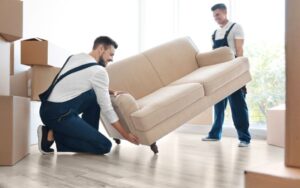
Establish a secure grip before lifting. Raise and move the sofa together without sudden jerks. Take small steps and keep movements predictable. Turn by moving your feet rather than twisting your body while supporting the furniture. If anyone loses their grip, communicate immediately and lower the sofa safely instead of trying to recover suddenly.
Put the sofa down before making adjustments
If the sofa needs precise positioning, lower it safely first whenever practical. HSE guidance specifically recommends putting a load down before making fine positional adjustments. This approach reduces prolonged holding and allows carriers to reset their grip before attempting another controlled movement.
Step 7: Move a sofa through a narrow doorway
Doorways often create the most challenging stage of a sofa move.
Never force the furniture simply because only a few centimetres remain. Pressure can damage upholstery, wooden frames, handles, paintwork and door trims.
Remove suitable obstacles first
Open doors fully and check whether handles or other removable obstacles reduce useful clearance. In some circumstances, safely removing a door from its hinges can create additional space, but only do this if you understand how to remove and reinstall it correctly. Clear nearby furniture so carriers have enough room to rotate.
Use controlled tilting and rotation
If measurements confirm enough clearance, carriers may need to tilt the sofa and gradually rotate it through the opening. Move slowly and watch every corner. One person should check clearances while the others maintain control. Stop immediately if the sofa begins trapping someone’s hand, catching the frame or becoming unstable.
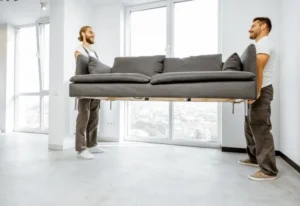
Step 8: Move a sofa on stairs carefully
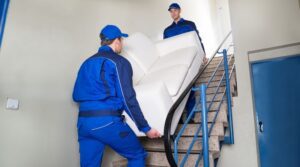
Stairs significantly increase the difficulty because carriers stand at different heights and cannot easily step away from the load.
Treat steep, narrow or turning staircases as higher-risk routes.
Measure stairs and landings carefully
Check staircase width, landing dimensions, ceiling clearance and turning space before starting. Compare these measurements with the sofa in several possible orientations. Remove suitable detachable sofa components where possible. If the geometry does not provide enough space for a controlled turn, professional movers may need to consider another practical approach.
Never rush an awkward staircase
Move one controlled section at a time and communicate continuously. Do not allow anyone to stand where an uncontrolled sofa could easily trap or fall onto them. If visibility disappears, grip weakens or the furniture becomes unstable, stop. HSE guidance identifies stairs, restricted movement and bulky loads as factors that increase manual-handling risk.
How to load a sofa into a removal vehicle
Reaching the vehicle does not finish the job. Poor loading can cause rubbing, pressure damage or movement during transport.
Decide where the sofa will sit before lifting it into the vehicle.
Protect the sofa during transport
Keep suitable covers around the upholstery and prevent sharp furniture edges from pressing against it. Do not stack heavy objects where they could apply damaging pressure to the sofa frame, arms or cushions. Arrange the surrounding load so nothing can shift significantly and strike the sofa while the vehicle moves.
Secure the sofa appropriately
Use suitable restraints where required and secure them against strong structural areas rather than vulnerable upholstery or delicate mechanisms. The goal involves preventing significant movement without creating damaging pressure. A professional removal team can plan the vehicle load alongside other furniture, boxes and household belongings to use available space more effectively.
When should you hire professional sofa movers?
DIY moving can work when the sofa remains manageable, the route stays straightforward and enough capable helpers and equipment are available.
Professional assistance becomes more valuable as weight, access difficulty or furniture value increases.
Get help for difficult sofas and access
Consider professional movers for large corner sofas, heavy sofa beds, recliners, valuable upholstery, narrow staircases and difficult apartment access. You should also consider help when you lack enough capable people or suitable transport. The safest decision may involve avoiding an uncontrolled DIY lift rather than attempting it simply to save time.
Reduce the physical workload of moving day
A removal team can handle the agreed furniture-moving tasks while you concentrate on keys, paperwork, children, pets, utilities and other moving responsibilities. Professional assistance can also help during full household moves where one sofa forms only a small part of a much larger collection of furniture and packed belongings.
Why choose Coxs Movers & Storage Ltd?
Coxs Movers & Storage Ltd currently offers house removals, commercial removals, packing, storage and related moving services. Its website also lists service coverage including Manchester, Wigan, Bolton, Cheshire and Worsley.
Customers should discuss individual sofa and access requirements before confirming a booking.
Explain the sofa and access before booking
Tell Coxs Movers & Storage Ltd about large corner sofas, recliners, sofa beds, stairs, lifts, narrow entrances and parking conditions when requesting a quotation. Accurate information helps the team understand the physical requirements before moving day. Mention detachable sections and unusual access instead of assuming every sofa requires the same handling approach.
Review the quotation carefully
Coxs Movers & Storage Ltd states that customers receive a quotation covering costs, services and terms before accepting a booking. Check exactly what your own quotation includes, including furniture handling, packing, storage or other requested support, so both sides understand the planned work before moving day.
Why people choose professional sofa movers
Trust should come from clear communication, accurate information and careful handling rather than vague promises.
A professional sofa move starts with understanding the furniture and route before lifting begins.
Clear planning improves the moving experience
Customers should explain measurements, access problems, stairs and furniture features before the move. Movers should communicate what preparation they expect from the customer. When both sides understand the route and agreed service, the team can spend moving day executing the plan rather than discovering avoidable access problems after lifting begins.
Compare service rather than price alone
When comparing movers, look beyond the lowest headline price. Consider what the quotation includes, communication, relevant services, customer feedback and possible additional charges. A realistic quotation based on the sofa, property and access conditions usually gives you more useful information than a cheap estimate that does not reflect the actual moving requirements.
Final sofa moving checklist
Before moving your sofa, confirm that you have:
- Measured the sofa and every narrow point.
- Checked stairs, lifts and turning spaces.
- Removed cushions and suitable detachable parts.
- Secured moving mechanisms.
- Cleared the complete route.
- Protected the sofa, flooring and vulnerable surfaces.
- Prepared suitable moving equipment.
- Arranged enough capable helpers.
- Agreed on commands and lifting positions.
- Checked the vehicle and loading plan.
- Planned how you will secure the sofa during transport.
If any stage still feels uncontrolled, change the plan before lifting.
Frequently asked questions
1. What is the safest way to move a sofa?
Measure the sofa and complete the route first. Remove loose and suitable detachable parts, protect the upholstery and property, clear obstacles and arrange enough capable helpers. Use suitable equipment and communicate during every movement. Move slowly and avoid twisting. If you cannot comfortably control the sofa, stop and arrange professional assistance.
2. Can you move a sofa without removing the legs?
Yes, when the sofa fits safely through the complete route with its legs attached. However, removable legs can reduce dimensions and make turning easier. Check manufacturer guidance before removal and keep fittings labelled. Measure first so you know whether removing the legs actually solves an access problem rather than dismantling them unnecessarily.
3. How many people are needed to move a sofa?
No fixed number suits every sofa. Weight, size, design, stairs and access determine how much help you need. Two capable people may control a small sofa on a simple route, while sofa beds or corner sofas can require additional assistance. If the handlers cannot maintain control throughout, get more help.
4. How do you move a sofa through a narrow doorway?
Measure the sofa and opening first, including the available turning space. Remove cushions and suitable detachable parts. Protect the sofa and doorway, then use controlled tilting or rotation only when measurements confirm enough clearance. Never force the sofa through. Extremely tight access may require professional assessment or further safe dismantling.
5. Should I hire professional movers to move a sofa?
Consider professional movers when the sofa is heavy, valuable, oversized or difficult to manoeuvre through stairs, lifts or narrow corridors. Professional help also makes sense when you lack suitable transport, equipment or capable helpers. Discuss the sofa and property access before booking so the mover can plan the work accurately.
Final thoughts
This sofa moving guide comes down to four principles: measure first, reduce unnecessary weight, control every movement and know when to get help.
A successful sofa move does not depend on strength or speed. It depends on understanding the furniture, planning the route, protecting surfaces, communicating clearly and using suitable equipment.
Coxs Movers & Storage Ltd currently provides removal, packing and storage services for customers who need professional moving support. If your sofa involves difficult stairs, restricted access or significant weight, explain these details before booking.
Taking a few extra minutes to prepare can prevent a sofa from becoming stuck in a doorway, reduce unnecessary property damage and make the entire move more controlled from the first lift to final placement.
Call to Action
 Call: Wigan: 01942 834 980
 Website: Coxs Movers & Storage Ltd
 Get a Free Quote Today
Coxs Movers & Storage Ltd — Manchester’s trusted name in removals.
Get Coxs Movers & Storage Ltd.’s Best Services